
In a Post-Apocalyptic World, One Man’s Secret Becomes a Fight for Survival
Once Upon a Time in the Apocalypse, directed by Tiago Pimentel, takes us into a world struggling to rebuild in the aftermath of nuclear devastation. As totalitarian regimes rise from the ashes and impose a new world order, survival comes at the cost of freedom, privacy, and trust. For Ernesto, keeping a dangerous secret hidden has become a matter of survival. But when a government inspector arrives at his doorstep, an ordinary encounter quickly turns into a tense psychological confrontation where every word, gesture, and hesitation could carry devastating consequences.
Set against the backdrop of a dystopian future, Once Upon a Time in the Apocalypse uses an intimate, contained encounter to explore the terrifying reach of authoritarian control. Rather than relying on the spectacle of a devastated world, Pimentel brings the tension into a deeply personal space, where suspicion and fear transform a seemingly routine inspection into a dangerous game of deception. It’s a chilling vision of a society where individual freedoms have all but disappeared, and where the smallest act of resistance can come at an unimaginable cost.
Below, we speak with director Tiago Pimentel about imagining a world shaped by nuclear catastrophe, building suspense through a psychological game of cat and mouse, and exploring the consequences of living under an oppressive regime.

Once Upon a Time in the Apocalypse imagines a world rebuilding itself after nuclear devastation. What first inspired this vision of the future?
Our visions of the future are almost always shaped by our experiences of the present and the past, and this was no different, unfortunately. We began writing Once Upon a Time in the Apocalypse at a time when two conflicts were threatening global stability, already fragile as it was: the war in Ukraine and the conflict in the Middle East. With the looming fear of nuclear war, I felt it was particularly relevant to show what humanity might look like in the aftermath of such a holocaust. More than that, I wanted to explore how war and dictatorship are tragically cyclical in nature, and how it only takes a few generations for collective memory to fade, making room for a new wave of populist demagogues.
The film presents a fascinating contrast between a post-apocalyptic future and the remnants of a forgotten past. How did you approach creating that sense of nostalgia within a dystopian world?
A famous quote attributed to Einstein kept echoing in my mind: “I know not with what weapons World War III will be fought, but World War IV will be fought with sticks and stones.” This idea of the mass destruction of the very foundations of Western civilization has always both frightened and fascinated me. The tension between humanity’s ability to evolve and its proclivity for self-destruction becomes all the more compelling as knowledge advances into technologies that allow us to live better than ever before, while also giving us the means to destroy more than ever before. Too often, the latter wins.
And then you have the remnants of the days of the old — the valve radio, the analog clocks, the Colonel's briefcase — all working to elicit that feeling of nostalgia you mentioned.
The production design is central to the film’s atmosphere, from the worn clothing to the smallest environmental details. How did your collaboration with Luis Sequeira help bring this world to life?
Working with Luís was an unforgettable experience. His professionalism and expertise were invaluable to the production. The level of detail he brought to each character — from the Colonel's imposing silhouette to the worn, layered textures of Ernesto's refuge — reminded me of why Guillermo del Toro's films, on which Luís has frequently collaborated, are so visually rich. He has a rare gift for making objects and spaces feel like they carry a history of their own.

The arrival of a government inspector transforms a seemingly quiet encounter into a tense psychological game. How did you approach building suspense within such a contained setting?
One of the first ideas I discussed with Tomás, our director of photography, was to shoot in a 4:3 aspect ratio to heighten the sense of claustrophobia already inherent in the setting. However, logistical constraints meant we had to use the house’s ceiling to accommodate the lighting setups, which made it difficult to achieve a full Open Gate image. I had to adapt and ultimately chose anamorphic lenses, knowing they would make the spaces feel much larger. That meant I needed to rely on other cinematic devices to build tension. One was the arrangement of the chairs: the Colonel initially sits on a simple chair, but in the second half he takes Ernesto’s rocking chair, symbolizing the shift in power between them.
I also played with the scale of the image. As the tension builds, we progressively increase the focal length and adjust the camera positioning, eventually arriving at something close to a Mexican standoff between Ernesto and the Colonel.
There’s something unsettling about humanity surviving a catastrophe only to fall back into authoritarian structures. What interested you in exploring that particular vision of society?
There is an undeniably cyclical nature to authoritarian regimes, one that is almost always tied to the politics of fear. Today, populists exploit public discontent by offering simple solutions to legitimate concerns, using false pretenses that are nevertheless easy to understand and believe. The fear they sell is the fear of outsiders, of those who are different from us. In the world of Once Upon a Time in the Apocalypse, the government uses the fear of air contamination to keep the population under control.
George Orwell understood this all too well when he wrote 1984. Hitler did so too.
The film’s world feels both fantastical and disturbingly plausible. How did you balance the visual elements of science fiction with a grounded sense of realism?
This was one of the project's greatest challenges, but also one of the aspects that fascinated me the most. The title itself embodies this contrast: is it possible to tell a “Once Upon a Time…” story in the midst of an apocalypse?
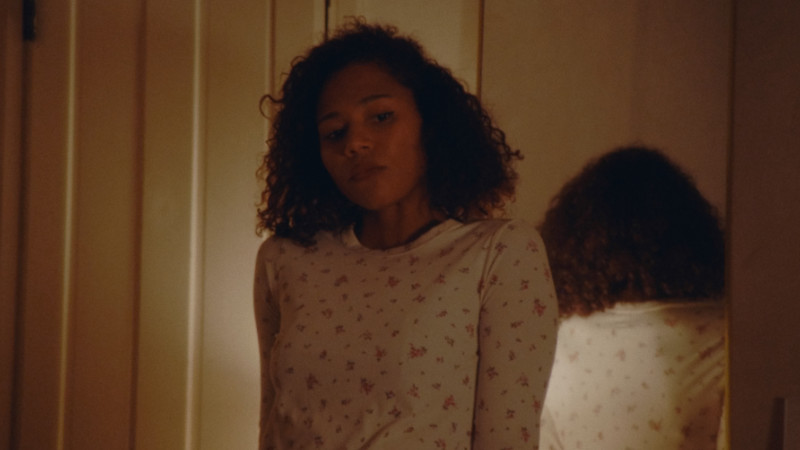
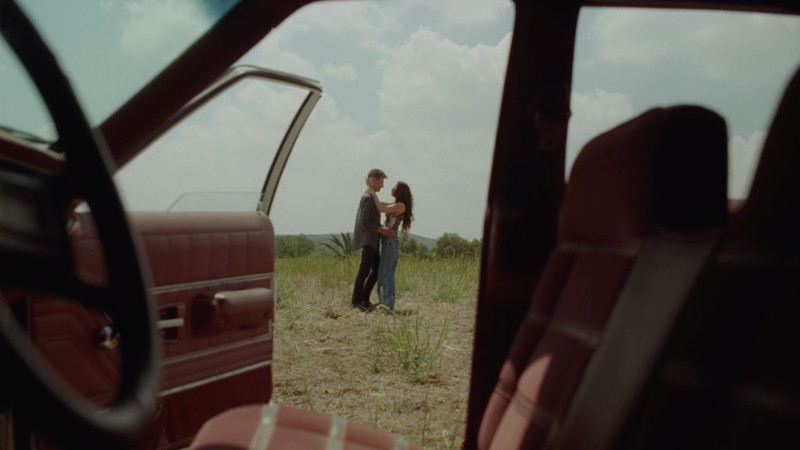
I shared this idea with Luís Sequeira and Tomás Brice. The use of brown tones in the interiors was essential to evoke the warm, comforting nostalgia of classic cinema. Lighting was equally important. I wanted the interiors to feel very warm, with carefully controlled yellow light, in stark contrast to the cold, greyish-blue light of the outside world.
Then there are smaller details that introduce a more fantastical dimension, such as the Colonel’s mask and Helena’s spiked walking stick. These elements help create a world that feels simultaneously familiar and strange, grounded in reality yet touched by something almost mythical.
Ernesto’s secret drives much of the narrative tension. How did you approach revealing information while keeping audiences questioning the characters’ intentions?
Suspense is a genre — I’m not particularly fond of the word, but I think it gets the point across — that I feel very comfortable working in. When I’m staging a scene, I’m constantly thinking about what I want the audience to know and what I want them to feel. Those two things are always interconnected, and you can play with them in different ways. Hitchcock, for instance, often let the audience know about the impending dangers ahead of the characters themselves, and thus fear for their safety.
With this film, I wanted the audience to feel as though they were always one step behind the characters. I wanted to create the sense that something else was going on, that something important remained unsaid. And not just in relation to a possible secret, but, above all, in relation to the characters’ very identities, which we gradually come to understand as the story unfolds.
At over 20 minutes, Once Upon a Time in the Apocalypse is considerably longer than a typical short film. What led you to embrace that runtime, and how did it influence your approach to storytelling and pacing?
I must admit that, initially, I thought the script would result in a slightly shorter film. But as soon as I began breaking down the sequences, I realized I would need time to build the tension, particularly through moments without dialogue.
There are moments of the exchanges between Ernesto and the Colonel that I deliberately extended in the edit because I felt that each line needed time to sink in and weigh on the audience’s minds. I also wanted the characters to feel as though they were genuinely thinking and reacting, rather than simply reciting lines from a script.
In the second act, there are moments when Colonel Salavisa takes several seconds to respond to Ernesto’s remarks, as though he were carefully planning his next move. It creates a genuinely diabolical sense of tension.

The film ends with a haunting question: what’s left of us when there’s nothing left? After watching Once Upon a Time in the Apocalypse, what do you hope audiences reflect on most?
I think that, if we’ve done our job well, the more viewers think about the film, the more questions they will have. I believe we’ve created a universe that extends far beyond the film’s 21-minute runtime, and I expect that world to occupy the minds of viewers immediately after watching it.
Then, I think they will inevitably begin questioning the motivations of what I consider to be the film’s most unsettling character: Helena.
The bloodstained smile on her face as she looks at the “secret” encapsulates the contrast at the heart of the title. Human beings will always crave fairytales, stories to help them make sense of the things that defy reason. But in a world where humanity has failed, enchantment will inevitably take on a dystopian quality.
What are the books, podcasts or even YouTube Channel that you recommend young filmmakers to get their hands on?
One of the most important skills a filmmaker can develop is an understanding of just how much depends on what you put in front of the camera. In fact, when making a short film, where we almost always work with micro-budgets, I wouldn’t hesitate to spend the entire budget on what appears in front of the camera rather than on the camera itself or other imaging equipment.
Meet the Gaffer is probably the best YouTube channel for learning how to light a set. A filmmaker doesn’t necessarily have to be a director of photography, of course, but understanding lighting is an essential part of the craft.
Can you share with us some of your favorite short films you’ve seen lately?
I really enjoyed The Long Goodbye (Watch on FS), directed by Aneil Karia. Although it was released in 2020, it continues to resonate with me because of the intensity and brutality with which it addresses a subject that, sadly, remains all too real.