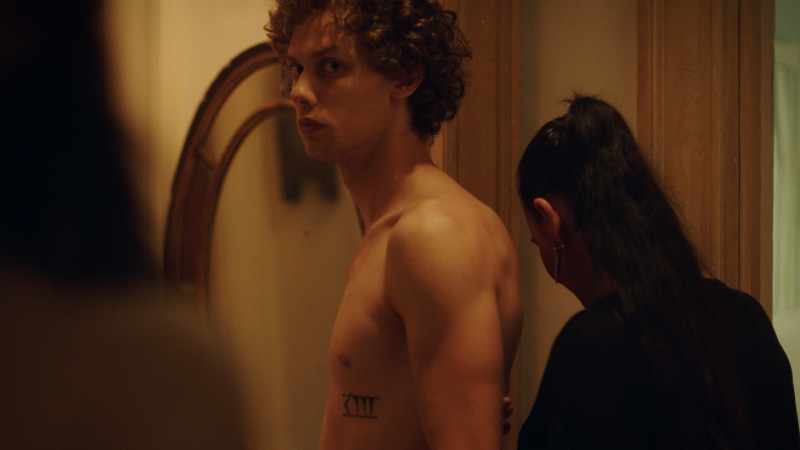

In the near future, man confesses a secret to his wife and receives a troubling response.
Director’s Vision for ‘Room For Error’
Room for Error is the first film I’ve made as part of a new ongoing film series/director’s collective I co-founded with fellow director Drew Vaughan titled The Slate. In The Slate, our group of other directors create films every four months based on a shared question-as-prompt (which remains secret outside of the group). Each film opens with a uniform slate to denote it’s membership in the project as well. The goal is to push ourselves outside of our comfort zones and create work that we otherwise may not have made by using these loose creative and scheduling guidelines, and Room for Error is exactly that. While I direct some narrative work on the commercial side, I’m primarily a documentary director and this is the first real narrative work I’ve done (aside from some student films 20+ years ago, which will hopefully never resurface).
Room for Error with themes that have loomed large in my life ever since my mom died a few years ago: death, grief, and technology. This specific story thread came to me after reading a brief mention of the development of “A.I. grief therapy” in Naomi Klein’s book “Doppleganger” which sounded like an absolutely terrible idea and therefore the perfect setup for a short. A few years ago, this premise might have required more of a visually-effected angle to make Patty’s character believable, whereas we’re now at a point where it’s not impossible to imagine that this type of “model” could look 100% realistic at some point in the near future. Once I convinced myself of this, it let me focus on creating a really simple story between the two, then three characters. We shot the main scene in the dining room of my house in Maplewood, NJ and placed Simon (the customer service rep)’s makeshift office in my basement; at first I imagined him in a proper office, but this type of tech startup corner-cutting felt more appropriate (and a lot more convenient, of course).My cinematographer Pete Quandt along with our one-man G&E team of Anthony Chen brought a look that really landed the tone. We wanted it to feel relatively warm and grounded at the start to establish George and Patty’s connection, but as the story developed we shifted, by way of blocking and lens choice, towards something a touch more tense and unsettled. On the post side we spent quite a bit of time finding the exact pacing that would allow for the conversations to breathe realistically earlier on and then creep towards the semi-surreal place we eventually land. My editor Deirdre Bell brought a lot out through shot selection specifically in reactions and expressions in a way that I hadn’t necessarily focused on during the shoot, and I think the music that Alex Weinstein composed for the film solidified the hard-to-define mix of emotion and humor that I was hoping we could achieve in the end.