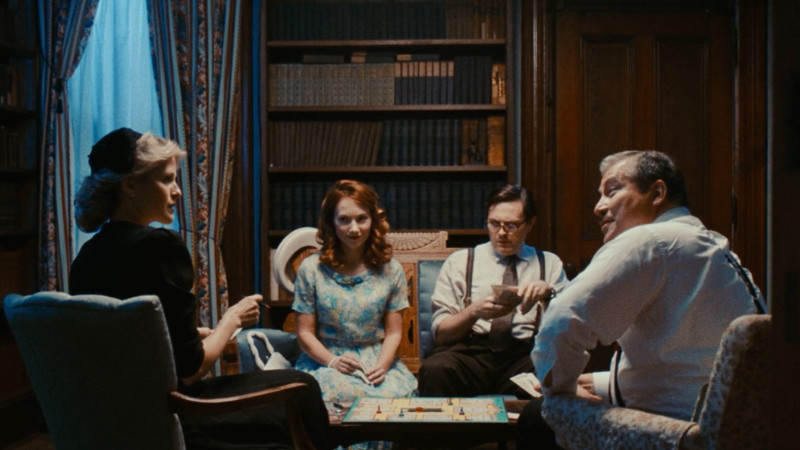

LUTÈCE is an experimental thriller set in an abandoned city consumed by violence and poverty. Two brothers struggle to survive honestly by running an underground bar, one of the last refuges in the heart of the chaos.
Their fragile balance collapses when the mafia terrorizing the city reveals its Don: their long-lost brother, who has returned to destroy Lutèce and erase the mistakes of the past.
Caught between survival, resentment, and fate, the brothers come to realize that in a dying world, no one can escape the legacy of previous generations—only choose how they will disappear alongside it.
Director’s Vision for ‘Lutèce’
LUTÈCE is a three-episode mini-series, conceived as both a narrative and visual experience, with the goal of building a strong atmosphere and a cohesive universe. The project consists of a 17-minute first episode, followed by two 7-minute episodes. This deliberately unbalanced structure reflects the state of the world it explores: fragmented, unstable, and doomed.
With LUTÈCE, I aimed to freely experiment with my tastes, references, and cinematic obsessions. The project is прежде all a creative playground, a space where I allow myself to explore different forms, rhythms, and visual languages, without seeking classical unity, but rather an emotional, thematic, and atmospheric coherence.
Each episode therefore adopts a radically different format.
The first episode is the most narrative-driven and the most “classical” in form. It draws inspiration from early American cinema, film noir, and urban thrillers. The staging is more restrained and readable, in order to establish the world of Lutèce, its characters, and the latent violence of the city. It is the narrative foundation, grounding the viewer in a familiar world before pulling them into rupture.
The second episode breaks sharply with this approach. Conceived as an almost silent chamber piece, it focuses on bodies, gazes, and space. Silence becomes a language in itself, evoking silent cinema, music videos, and advertising. Time stretches, action tightens, giving way to an almost abstract tension—more sensory than narrative—with music as its guiding force.
The third episode is structured around a long voice-over, which tells the story like a dark, disenchanted fairy tale. This choice creates distance from both characters and events, as if Lutèce were already a legend, a myth told after its disappearance. The voice transforms violence and desolation into narrative, giving chaos a poetic form.
The music, which I composed myself, plays a central role in the universe of LUTÈCE. It does not merely accompany the images: it structures the episodes, defines rhythm, sometimes replaces dialogue, and becomes a true emotional vector. In a world where words fail or lose their meaning, music acts as an inner voice—a resonance of the city and its inhabitants—amplifying the sense of desolation, tension, and fatality.
Through these three forms, LUTÈCE explores the inevitability of a world inherited from the mistakes of past generations. A world where one only walks through already-existing ruins, where destruction sometimes becomes the only promise of a possible future. More than a story about mafia or brotherhood, the series questions our relationship to inheritance, repetition, and the illusion of choice.
LUTÈCE is a free, dark, and experimental work, born from the desire to create without compromise, to experiment, to play, and to embrace the pure pleasure of mise-en-scène.